There’s a number I’ve seen stop agencies dead in their tracks more reliably than any single bad campaign, difficult client, or market downturn. It’s 15. Specifically, somewhere between 12 and 15 clients, almost every growing agency hits the same invisible wall — and it has nothing to do with their campaigns.
The media buying is sharp. The creative work is solid. Consequently, the client results are mostly there. However, the agency grinds to a halt anyway — because the operational scaffolding underneath the work was never built for this size.
Furthermore, in my experience, the first place that scaffolding cracks is always reporting. Always.
The 15-Client Wall — What’s Actually Breaking
Let me describe what “hitting the wall” looks like from the inside. Specifically, at 8 clients, a single account manager handles reporting manually and manages the workload — just. Furthermore, at 12, they start working evenings. Moreover, at 15, the reports start slipping. Consequently, some go out three days late. Others get built in a rush with copy-pasted summaries from previous months. Therefore, quality degrades across the roster — not because the team stopped caring, but because the workflow ran out of hours.
This isn’t a talent problem. It’s a systems problem. Furthermore, it’s entirely predictable once you understand the maths.
“I consulted with a performance agency that had been stuck at $340k annual recurring revenue for two years. They kept hiring to solve the growth problem — a new account manager, then a junior strategist, then a part-time analyst. However, headcount kept rising faster than revenue. When I mapped their time allocation, I found they were spending 47% of billable hours on reporting activities. Consequently, the more clients they signed, the more they hired, and the worse their margins got. The root cause wasn’t growth — it was an unscalable reporting workflow dragging everything down.”
The Maths That Make Manual Reporting Unscalable
Manual reporting doesn’t scale linearly. Furthermore, it scales worse than linearly — because each new client adds both direct reporting time and coordination overhead. Therefore, let me show you exactly what happens to an account manager’s capacity as the client roster grows.
Account Manager Reporting Hours — Manual vs Automated
Specifically, at 15 clients on a manual workflow, an account manager spends 75 hours — nearly half their working month — just on reporting. Consequently, strategy work, optimisation, and client communication all get squeezed into the remaining hours. Therefore, campaigns suffer, clients feel neglected, and churn accelerates exactly when the agency needs stability most.
The Wrong Solution Most Agencies Reach For
When agencies hit the 15-client wall, their instinct is to hire. Furthermore, that instinct makes sense on the surface — more clients means more work, and more work means more people. However, hiring to solve a workflow problem is like adding more lanes to a road with a broken traffic light. Consequently, you move more cars into the jam rather than fixing the jam itself.
Moreover, hiring adds its own overhead. Specifically, a new account manager needs onboarding, training, and a client handover period. Furthermore, they bring their own variations to the reporting process — different templates, different interpretation of metrics, different communication rhythms. Therefore, quality inconsistency across the client roster gets worse, not better.
Why the Hire-First Approach Destroys Margins
Furthermore, the economics of hire-first scaling are genuinely painful. Specifically, a junior account manager costs $28,000 to $35,000 a year in salary alone — before tools, benefits, and management time. Consequently, to justify that hire, you need three or four additional retainers just to stay margin-neutral. Moreover, those new retainers generate more reporting work, which accelerates the next hiring cycle. Therefore, the agency grows in headcount without growing in margin — exactly the trap that keeps agencies stuck below $500k ARR indefinitely.
The margin trap in numbers: If your average retainer is $2,500 per month and you hire one AM at $32,000 per year to handle reporting growth, you need 12 months of one extra retainer just to break even on the hire. However, if you implement automated client reporting instead at a fraction of that cost, the same existing AM handles the additional clients — and the entire retainer value falls to your bottom line.
The Structural Fix — Building for Scale Before You Need It
Here’s the principle I keep coming back to after 22 years in this space. The best time to build automated client reporting infrastructure is before you need it. Specifically, at 8 clients, the cost of implementation is low and the benefit is immediate. Furthermore, at 15 clients already in crisis mode, implementation competes with fires. Therefore, the agencies that scale cleanest are the ones that treat reporting automation as infrastructure from day one — not as a rescue tool.
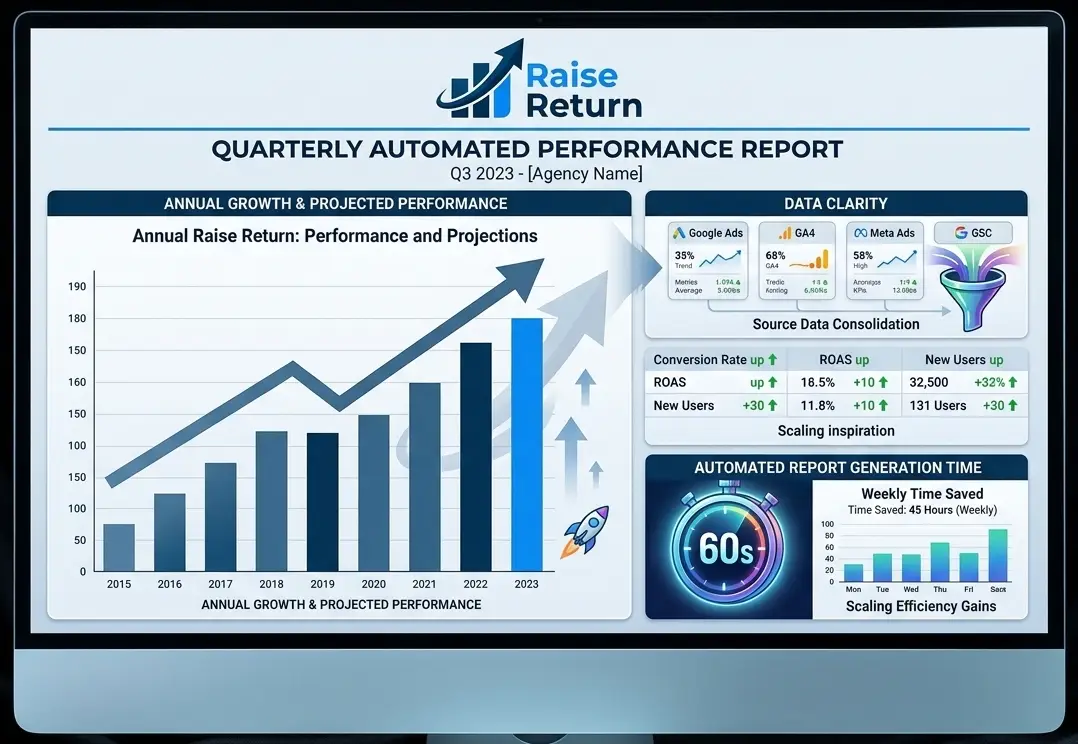
Agencies that implement automated client reporting early build a growth model where adding clients costs almost no additional operational overhead.
Manual reporting still feels manageable
Furthermore, at this size, manual reporting takes around 25 to 30 hours per month. Specifically, one AM handles it without obvious strain. However, the habits and templates you build here become the foundation for everything that follows — so building automation early locks in quality before inconsistency creeps in.
The strain becomes visible — but manageable if you act now
Consequently, reporting starts consuming 40 to 60 hours monthly. Moreover, the first quality inconsistencies appear — different AMs using slightly different templates, summaries getting shorter as time runs out. Therefore, this is the ideal window to implement automated client reporting before the wall arrives.
The wall hits hard — and hiring won’t fix it
Furthermore, this is where agencies typically panic-hire. Specifically, reporting takes 75-plus hours monthly across the team. Moreover, quality degrades visibly — late reports, generic summaries, platform number mismatches. Consequently, churn accelerates and the agency enters a costly hire-and-replace cycle that destroys margins.
Automated client reporting makes this growth feel frictionless
However, with automated client reporting in place, adding five new clients costs five additional 15-minute review sessions per month. Therefore, growth feels light rather than crushing. Furthermore, report quality stays consistent regardless of team size or month-end pressure — because the system handles the production layer entirely.
Hire vs Automate — The Decision That Defines Your Growth Ceiling
I want to be direct about something, because I think most agency owners frame this decision incorrectly. Specifically, hiring and automating aren’t mutually exclusive — but the order matters enormously. Furthermore, automation should come first, and hiring should come only when automation has been maximised and you genuinely need more strategic capacity.
Therefore, here’s how those two paths compare against every dimension that matters for a scaling agency.
- $28k–$35k salary per hire before ROI
- 3–4 months onboarding before full productivity
- Reporting quality varies by individual
- Each hire adds management overhead
- Headcount scales with client count linearly
- Margin stays flat or shrinks as you grow
- New hires create new reporting inconsistencies
- Reporting bottleneck returns with each growth phase
- Fraction of one salary — immediate ROI
- Setup in one afternoon, live same day
- Consistent quality across all clients always
- Zero additional management overhead
- Existing team manages 3× more clients
- Margin improves as revenue grows
- Every client gets the same branded experience
- Each growth phase costs less than the last
What Automated Reporting Does to Your Marketing Strategy at Scale
There’s a strategic dimension to this that most agency owners underappreciate. Specifically, manual reporting doesn’t just consume time — it consumes the thinking capacity that makes a marketing strategy worth executing. Furthermore, an account manager who spends 40% of their month formatting GA4 tables and chasing Meta export bugs has 40% less cognitive bandwidth for campaign optimisation and client insight.
Consequently, when automated client reporting removes the production layer, something interesting happens to strategic quality. Moreover, account managers who previously described their work as “reactive” start describing it as “proactive.” Therefore, they spend time on things that move performance — creative testing, audience analysis, bid strategy adjustments — rather than on things that just document it.
“You don’t scale a marketing strategy by working harder. You scale it by making sure your best people aren’t wasting half their month on work a machine can do in 60 seconds.”
The Compounding Strategy Advantage
Furthermore, consider what this means over a 12-month horizon. Specifically, an agency where account managers spend 40 additional hours per month on strategic work — rather than manual reporting — produces measurably better campaign outcomes over time. Moreover, better campaign outcomes drive higher client ROAS, stronger renewals, and more word-of-mouth referrals. Consequently, the agency grows faster from its existing clients rather than constantly replacing churned ones with new acquisitions.
Therefore, automated client reporting isn’t just an operational fix. It’s a competitive advantage that compounds directly into the quality and results of your marketing strategy at every scale.
Specifically, every hour you return to an account manager through automated client reporting is an hour available for client strategy, campaign optimisation, or relationship development. Furthermore, those activities have a direct multiplier effect on client ROAS and retention. Therefore, the ROI of automated reporting isn’t just the hours saved — it’s the compounding value of what those hours become when redirected toward work that actually moves the needle.
What Getting Set Up Actually Looks Like
One of the most common objections I hear from agency founders is that implementation feels daunting. Specifically, “we don’t have the bandwidth to migrate our reporting workflow right now.” Furthermore, I understand that instinct — but it’s backwards. Consequently, the less bandwidth you have, the more urgently you need automated client reporting in place.
Moreover, the setup process is genuinely lightweight. Specifically, RaiseReturn connects to GA4, Google Ads, Meta Ads, Search Console, and PageSpeed via OAuth 2.0 in a few clicks per client. Furthermore, your branded template gets configured once and applies to every report you generate. Therefore, most agencies are fully set up and running their first automated client reports within a single afternoon.
The First Month Payback
Specifically, in month one, you recover the setup time within the first reporting cycle — typically saving 40 to 60 hours of manual work across your team. Furthermore, from month two onwards, those hours stay recovered permanently. Consequently, you effectively lower your cost-per-client every single month automated reporting runs. Moreover, as you add new clients, the marginal cost of serving each one shrinks rather than grows. Therefore, the unit economics of your agency fundamentally improve — and they keep improving as the client roster scales.
Real outcome at scale: Agencies that implement automated client reporting at the 8 to 12 client stage typically reach 30 to 40 clients with the same team size they had at 15. Furthermore, they do it with better report quality, lower churn, and higher margins — because growth stops competing with operational capacity. Moreover, the founder stops doing late-night spreadsheet sessions and starts making actual strategic decisions about where the business goes next.
Common Questions About Scaling With Automated Client Reporting
Break through your growth ceiling
RaiseReturn connects to GA4, Google Ads, Meta Ads, GSC, and PageSpeed — and generates fully branded, AI-written automated client reports in under 60 seconds. Scale from 10 to 50 clients without adding headcount. First 30 days free, no card required.
Start Your Free Trial →The 15-client wall isn’t inevitable. Specifically, it’s a workflow problem — and workflow problems have engineering solutions. Furthermore, the agencies that break through it cleanest are the ones that automate reporting before the wall arrives, not after it stops them.
Build the system now. Scale without the ceiling.