Most agencies have a reporting problem they haven’t named yet. They call it “admin overhead.” They call it “end-of-month chaos.” Sometimes they just call it Tuesday night. But strip away the polite language and what you actually have is a broken data pipeline sitting directly underneath every marketing strategy decision they make.
That’s the real issue. Not the campaigns. Not the budget allocation. The broken pipeline.
I spent years building data infrastructure for companies before I got obsessed with agency workflows specifically. Furthermore, I watched the same pattern repeat itself across dozens of organisations — smart people, strong strategy instincts, genuinely good media buyers — all operating on data that was one to three weeks old. Consequently, by the time a report surfaced a problem, the budget had already bled for another fortnight.
What I Kept Seeing Inside Agency Tech Stacks
Here’s what a typical mid-size agency’s reporting workflow actually looked like when I started digging into it. An account manager would open GA4, export a CSV for the date range. Then they’d jump to Google Ads, download another export. After that, they’d wrestle with the Meta Business Suite — which, if you’ve spent any time in that interface, you know is essentially a masterclass in user hostility. Finally, they’d stitch everything together in a Google Sheet with VLOOKUP formulas that broke every third month when a column shifted.
Specifically, the bit that used to make me grind my teeth: they’d repeat this for every single client. Every. Single. Month.
However, the problem wasn’t effort. These people worked incredibly hard. The problem was architecture. They had no pipeline — just a series of manual handoffs pretending to be a process.
“I once audited an agency with 14 clients and found they were spending 71 hours a month on reporting. That’s nearly two full working weeks. Moreover, the reports they produced still had errors — wrong date ranges, mismatched platform numbers — because human beings make mistakes at 11 PM.”
The Gap Between Marketing Strategy and Marketing Reality
Here’s something I believe strongly: a solid marketing strategy is only as good as the feedback loop underneath it. Therefore, if your data arrives three weeks late, your strategy is technically navigating blind.
Think about what that means in practice. Your paid media buyer spots a CPA spike — but only after the monthly report surfaces it. Your SEO team notices an organic traffic drop — after the client already emailed asking what happened. Your whole operation runs on yesterday’s intelligence, trying to make tomorrow’s decisions.
This isn’t a people problem. It’s a systems problem.
Why Manual Data Pulling Poisons Strategic Decisions
Manual data pulling introduces something engineers call latency. In a database context, latency is the delay between an event occurring and a system recognising it. For an agency, that latency sits between a campaign underperforming and someone actually doing something about it.
Furthermore, manual processes introduce inconsistency. One month, the report covers April 1 to April 30. The next, someone accidentally pulls March 28 to April 27 because the date picker defaulted wrong. Consequently, MoM comparisons become meaningless. Therefore, the strategic layer — the part where leadership decides what to do next — operates on corrupted inputs.
That’s not a reporting problem. It’s a marketing strategy problem.
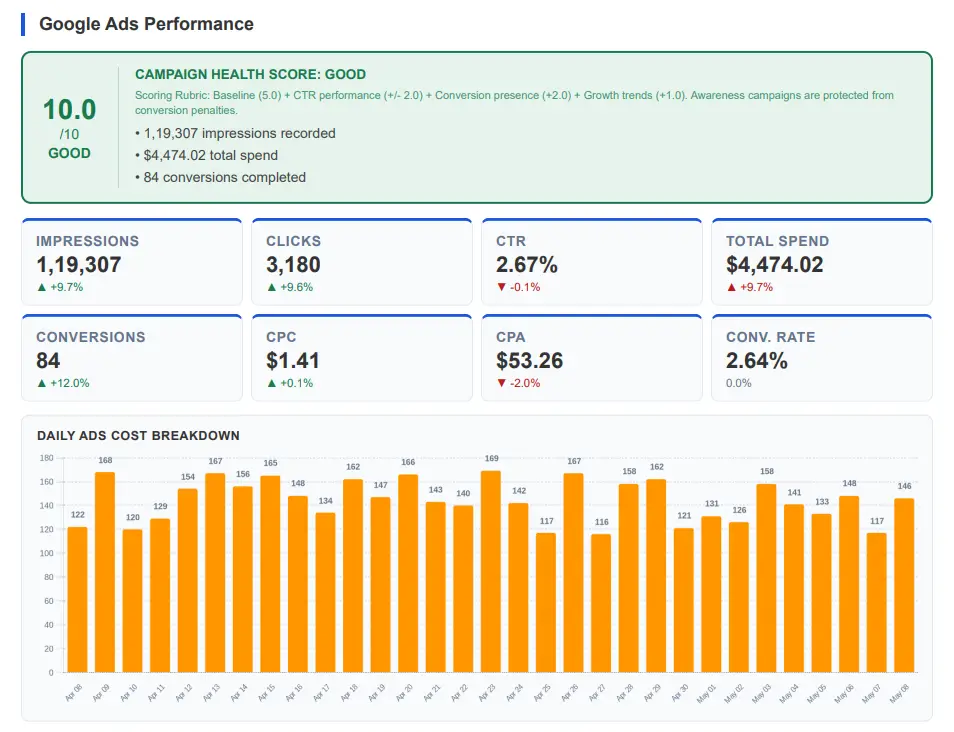
A proper reporting pipeline connects every data source via API — eliminating the manual export-paste-format cycle that burns agency hours every month.
Where SEO and Digital Marketing Gets This Wrong Specifically
SEO and digital marketing teams have a particularly acute version of this problem. Organic performance changes constantly. Rankings shift daily. However, most agencies review GSC data once a month in a report they built the previous Friday night.
Specifically, here’s what that looks like in the data. A client’s top-ranking page drops from position 2 to position 11 during a core algorithm update on the 8th of the month. The agency’s next scheduled report goes out on the 1st. So the client finds out about a 78% traffic drop — three weeks after it happened.
In seo digital marketing, three weeks is an eternity. Furthermore, the window to respond quickly — to push a content update, fix a technical issue, shore up internal linking — closes fast. Consequently, by the time the manual report surfaces the problem, the opportunity to respond effectively has already narrowed significantly.
Automated reporting doesn’t just solve the speed problem. It changes what’s possible strategically.
When your GSC data updates automatically each morning and flags anomalies in real time, your SEO team operates like a trading floor — reacting to live signals rather than historical snapshots. Therefore, automated reporting transforms seo and digital marketing from a reactive discipline into a genuinely proactive one.
What an Actual Automated Reporting Pipeline Looks Like
Let me get specific here, because I think most people underestimate how simple a well-built pipeline actually is once someone has done the hard API integration work for you.
Here’s the basic data flow inside RaiseReturn:
Each source connects via OAuth 2.0 and pulls data on a defined schedule. Consequently, there’s no human touching the data between the platform and the report. However, the account manager still steps in at the final stage — reviewing the AI-written summaries, adding strategic commentary, checking for anomalies before delivery.
That’s it. Specifically, the complexity isn’t in the logic — it’s in maintaining stable OAuth token refresh cycles, handling API rate limits gracefully, and normalising data models across platforms that define “conversion” differently. Furthermore, we’ve spent years building the reliability layer so agencies don’t have to.
What Actually Changes When You Automate
I want to be honest here, because I’ve seen too many software vendors oversell this. Automation doesn’t fix bad strategy. However, it does remove the data latency that makes good strategy impossible to execute at speed.
Specifically, here’s what changes for the teams that implement this properly.
Account Managers Stop Being Data Janitors
This is the shift I care about most. Account managers are smart people. Therefore, they should spend their time on strategy, client relationships, and creative problem-solving. Instead, most of them spend a significant portion of each month copy-pasting numbers between spreadsheets and reformatting tables.
Automated reporting eliminates that entirely. Furthermore, because the AI-written summaries handle the first draft of every narrative section, account managers shift from production mode to editorial mode. Consequently, they read, refine, add insight, and move on. That’s a completely different job — and a much better one.
Clients Stop Feeling Left in the Dark
However, the change clients notice most isn’t the report quality — it’s the consistency. A report that arrives on the 1st of every month, without fail, without excuses, becomes a reliable rhythm. Moreover, that rhythm builds a specific type of trust that’s almost impossible to quantify but extremely easy to lose.
Furthermore, mid-month pulse reports become genuinely feasible when automation handles the data pull. Therefore, instead of one monthly touchpoint, agencies can establish a weekly cadence for higher-spend clients — without any additional labour cost.
Real outcome: Agencies using RaiseReturn typically go from one monthly report per client to a weekly pulse update plus a full monthly report — with the same team size. Furthermore, client satisfaction scores measurably improve within 90 days, specifically because clients feel more informed between calls.
How This Rebuilds Your Marketing Strategy from the Ground Up
Here’s the strategic argument I want to make clearly. A marketing strategy built on weekly data operates in a fundamentally different mode than one built on monthly data. Moreover, the difference isn’t incremental — it’s structural.
With monthly data, your strategy is post-mortem. You look back at what happened, form a hypothesis, and apply it next month. However, with automated daily or weekly data, your strategy becomes iterative. You test, observe, adjust, and test again — within the same campaign cycle.
Specifically, this changes how you approach budget allocation. Furthermore, it changes how you run creative testing on Meta. Additionally, it completely transforms how your seo and digital marketing team responds to ranking movements. Therefore, the compounding advantage over a 12-month period is significant — and it all stems from removing the reporting bottleneck at the foundation.
“Give me a team with average strategy and real-time data, and I’ll beat a team with brilliant strategy and monthly data — every single time.”
The Specific Mistakes I Still See Agencies Make
After years of watching agencies implement automated reporting — badly and well — I keep seeing the same errors. Specifically, here are the three that cost the most.
Automating the wrong metrics
Some agencies automate whatever is easy to pull and call it done. Consequently, they end up with automated reports full of vanity metrics — impressions, reach, follower counts — that their clients don’t actually care about. Therefore, before you automate anything, build a clear map of which metrics matter for each client’s business goals. Furthermore, make sure those are the metrics that drive the report narrative.
Skipping the human review step
Automation generates the report. However, automation doesn’t understand that a conversion spike on the 14th was caused by a promo code leak on Reddit, not a campaign improvement. Therefore, a human review step is non-negotiable. Specifically, this should take 10–15 minutes per client — not hours. If it takes longer, your automation isn’t doing enough of the heavy lifting yet.
Not connecting reporting to decisions
Furthermore, the most common mistake is treating automated reporting as a deliverable rather than a decision-support tool. Consequently, reports go out, clients acknowledge them, and nothing changes inside the agency’s workflow. Therefore, every automated report should close with a “next actions” section — specific decisions the data is informing. Moreover, that section is what transforms reporting from a compliance exercise into genuine competitive advantage.
Watch out for this: Automating a bad report template just delivers bad reports faster. Therefore, before you build an automation layer on top of your monthly marketing report, fix the structure first. Specifically, make sure every section serves the client’s understanding — not the agency’s production convenience.
Common Questions About Automated Reporting and Marketing Strategy
Stop navigating on stale data
RaiseReturn connects to GA4, Google Ads, Meta Ads, GSC, and PageSpeed — and generates fully branded, AI-written reports in under 60 seconds. Give your marketing strategy the real-time backbone it actually needs. First 30 days free.
Start Your Free Trial →One Last Thought From Someone Who’s Seen Both Sides
I’ve built manual reporting workflows. Furthermore, I’ve built automated ones. Therefore, I can tell you with absolute certainty which one produces better outcomes — not just for efficiency, but for the quality of decisions that come out the other side.
Manual reporting keeps your team busy. Automated reporting keeps your team sharp. Moreover, in a competitive agency environment where every team is fighting for the same clients, sharp beats busy every single time.
Specifically, your marketing strategy is only as intelligent as the data feeding it. Therefore, fix the pipeline first. Furthermore, everything else — the campaign creativity, the channel mix decisions, the client conversations — gets better automatically when the data underneath it is clean, fast, and reliable.
Build the backbone. The rest follows.