Here’s a hard truth that most agency owners don’t want to sit with: your clients usually don’t leave because your campaigns underperformed. They leave because they didn’t feel like you were paying attention.
Think about the last few clients you lost. Was it really about the numbers? Or was it about a missed check-in, a confusing report, or a period of silence when they needed reassurance?
Client churn is one of the most expensive problems a growing agency faces. And yet, most agencies keep throwing more money at acquisition rather than fixing the retention leak. The average agency loses around 30% of its client base every year. That’s a treadmill. And it’s exhausting.
The good news? A huge chunk of that churn is preventable. And it starts with something way simpler than you might think — what your clients see every month.
Agencies that send consistent, clear, and branded reports see significantly better retention. Not because the reports fix poor performance — but because they build the trust that keeps clients around long enough to see results.
The Real Reason Clients Leave
Ask a churned client why they left and they’ll usually say something polite. “We’re going in a different direction.” Or “We’ve decided to bring things in-house.” But dig a little deeper, and a pattern emerges.
They felt left in the dark. Simple as that.
Between monthly calls, clients are sitting with a lot of questions. Is this working? What did we spend last week? Did that campaign do anything? When there are no clear answers coming through, anxiety fills the gap. And anxiety leads to second-guessing. And second-guessing leads to Googling other agencies.

Regular touchpoints and clear data keep clients confident — even during slower months.
It’s not always about bad results, either. Some of the stickiest agency-client relationships survive rough patches — slower months, algorithm shifts, seasonal dips. They survive because the client feels like they’re in it together. They’re getting regular updates. Their agency is being honest about what’s working and what isn’t. They trust the process.
On the other hand, even a client seeing strong ROAS can walk out the door if they feel like they don’t really know what’s going on. Confidence isn’t just built by results. It’s built by visibility.
“Your clients don’t just want good results. They want to feel like they’re not flying blind. A report isn’t just data — it’s proof that you’re showing up.”
The Reporting Gap Most Agencies Don’t Notice
Here’s where it gets interesting. Most agencies genuinely believe they’re communicating enough. But their clients tell a completely different story.
This gap happens for a few reasons.
First, reporting is painful. It takes forever. So it gets pushed to the last possible moment, right before the monthly call. By then, the account manager is rushed, the report is basic, and there’s barely time to actually talk through what it means.
Second, the reports themselves are often confusing. A wall of GA4 numbers. A screenshot from Google Ads. A Meta campaign table that takes three minutes to decode. Clients nod along on the call but walk away not really understanding what happened — or whether it was good or bad.
Third, there’s no rhythm between calls. A month of silence is a month for doubt to grow.
Worth checking: If your team is spending more than 4 hours per client on monthly reporting, you’re almost certainly cutting corners somewhere — either on quality, frequency, or both. That’s the double hit: burned hours and still underwhelming output.
What Good Client Reporting Actually Looks Like
Good reporting isn’t complicated. But it does need to hit a few things consistently.
It arrives on time, every time
Consistency signals professionalism. A report that lands on the same day every month — without the client having to chase it — builds quiet confidence over time. It tells them you’re organised, you’re on top of it, and they don’t need to worry.
It looks like it came from you
Branded reports matter more than most agencies realise. A polished, white-labelled report with your agency’s logo and colours says “we made this for you.” A generic spreadsheet export says “we ran out of time.” Clients notice the difference, even if they never say it out loud.
It tells a story, not just a number
Numbers without context are noise. A good report explains what happened, why it happened, and what you’re doing about it. That narrative layer — even just a paragraph or two of plain-English summary — is what makes clients feel understood rather than just billed.
It covers the channels that matter to them
An e-commerce client needs to see ROAS and Meta performance front and centre. A local services business cares about calls and GSC visibility. Don’t send every client the same template. Tailor the sections to what their business actually runs on.
How Automated Reporting Closes the Gap
The reason most agency reports are late, generic, or inconsistent isn’t that account managers don’t care. It’s that building a proper report manually takes hours they simply don’t have.
So naturally, corners get cut. Reports get delayed. The polish disappears. And the client experience quietly suffers every single month.
Automated reporting solves this at the root. Instead of your team spending four to six hours per client pulling data, formatting spreadsheets, and stitching together a deck — the whole thing gets generated in under 60 seconds. Branded. Formatted. With an AI-written narrative summary ready for a quick review.
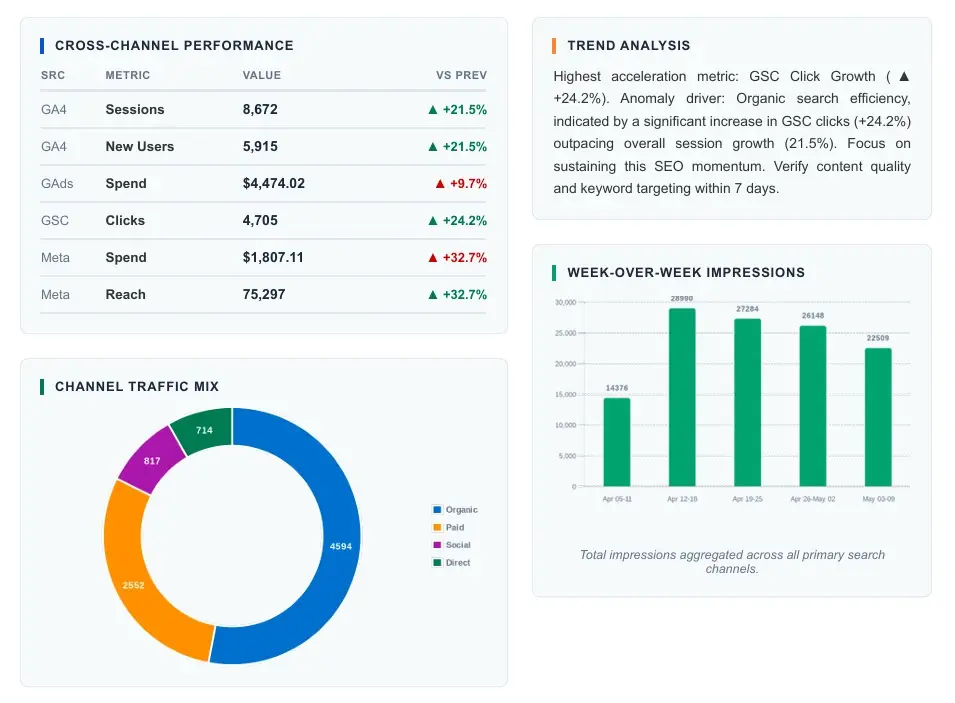
Automated reports pull live data from GA4, Google Ads, Meta, GSC and more — then wrap it in a client-ready format.
That frees your team to actually think. Instead of formatting cells, they’re reading the numbers, spotting the story, and adding the strategic layer that makes a report genuinely useful.
The result? Reports go out on time. They look good. And clients start to feel that steady rhythm of communication that keeps trust alive between calls.
Stop losing clients to silence
RaiseReturn generates branded, AI-powered reports from GA4, Google Ads, Meta, GSC, and PageSpeed — in under 60 seconds. Your first 30 days are free, no credit card needed.
Start Your Free Trial →3 Retention Habits to Build Around Your Reports
Better reports are the foundation. But there are a few simple habits that compound the effect and make churn almost a non-issue.
Send a mid-month pulse update
You don’t need a full report every two weeks. Even a short email — “here’s where we’re tracking at the halfway point, here’s what we’re watching” — goes a long way. It breaks the silence and reminds clients their account is active and monitored.
Lead with wins, then explain the dips
Structure your report narrative to open with what went well before diving into what needs attention. Clients who feel recognised for progress are far more patient when you explain a challenging period. It’s a small psychological shift that makes a real difference in how feedback lands.
Make the next steps obvious
Every report should end with a clear “here’s what we’re focusing on next month.” It closes the loop and positions you as proactive rather than reactive. Clients who know what’s coming next don’t go looking for other agencies.
Quick win: Add a simple “Next 30 Days” section to your report template. Even three bullet points of planned activity gives clients a sense of direction — and something concrete to look forward to on the next call.
The Bottom Line
Client churn isn’t just an acquisition problem. It’s a communication problem. And for most agencies, the communication breaks down right there in the monthly report — when it’s late, when it’s confusing, or when it simply doesn’t show up at all.
The fix isn’t complicated. It’s about showing up consistently, making the data easy to understand, and giving clients the feeling that you’re genuinely on top of their account.
Automated reporting makes that sustainable. Because when it doesn’t take your team half a day to build a report, they actually send them. On time. Every time. With the quality that keeps clients confident and loyal.
Your clients hired you to grow their business. Help them see that you’re doing exactly that — every single month.