Google Ads holds some of the richest customer intent data any marketing channel produces. Search terms show exactly what language people use when they’re ready to buy. However, most of that insight never leaves the campaign dashboard. It gets used to adjust bids and pause keywords — then it disappears.
That’s a strategic loss most agencies don’t even notice.
Specifically, the account manager running Google Ads knows which messaging converts, which audience segments respond, and which search terms signal real buying intent. Furthermore, none of that knowledge typically makes it into the quarterly strategy conversation, the content calendar, or the positioning decisions the wider marketing team makes. Consequently, agencies end up running two parallel operations — tactical campaign management and strategic planning — that barely talk to each other.
Why Google Ads Data Gets Trapped in Its Own Silo
Specifically, this disconnect isn’t a failure of intelligence or effort. Furthermore, it’s a structural consequence of how agencies typically organise reporting and strategy work. PPC specialists live inside the Google Ads interface daily — checking search terms, adjusting bids, testing ad copy. However, strategic planning happens monthly or quarterly, usually in a completely different meeting, often reviewing a summary report that strips out the granular detail that actually matters.
Consequently, by the time strategic conversations happen, the specific insight — the exact phrase a customer typed before converting, the particular objection an ad addressed successfully — has already been abstracted into a single ROAS number. Therefore, the strategy team makes decisions based on outcomes without access to the reasoning behind them.
“Our Google Ads specialist found that search terms containing ‘same day’ converted three times better than anything else. She adjusted bids accordingly and moved on. It took me four months to find out — completely by accident in a random conversation — and once I knew, we rewrote our homepage headline around it. That insight sat in a spreadsheet for four months doing nothing for the wider marketing strategy.”
What Marketing Strategy Misses When Google Ads Stays Siloed
Specifically, the cost of this disconnect isn’t abstract. Furthermore, it shows up in concrete missed opportunities across the marketing function — decisions made without access to some of the clearest customer signal available.
- Website copy ignores proven high-converting language
- Content calendar misses topics search terms reveal as high-intent
- Email messaging doesn’t reflect what actually converts in ads
- Budget decisions happen without cross-channel context
- Sales team lacks insight into what messaging pre-qualifies leads
- Organic SEO strategy misses proven commercial keyword intent
- Website headlines mirror language proven to convert
- Content plan prioritises topics with demonstrated buying intent
- Email sequences reuse messaging themes that outperform
- Budget shifts toward channels supporting proven demand signals
- Sales conversations reference the exact pain points ads addressed
- SEO targets commercial terms Google Ads data already validated
Specifically, none of the right-hand column requires new data. Furthermore, it requires the data that already exists inside the Google Ads account to travel somewhere it currently doesn’t go. Consequently, closing this gap is less about collecting more information and more about building a bridge for information that’s already been collected.
Four Types of Google Ads Insight That Should Shape Marketing Strategy
Specifically, not every piece of Google Ads data belongs in a strategy conversation. Furthermore, some insights are tactical and stay tactical — daily bid adjustments don’t need a board meeting. However, four specific categories of Google Ads insight carry strategic weight well beyond the paid search account itself.
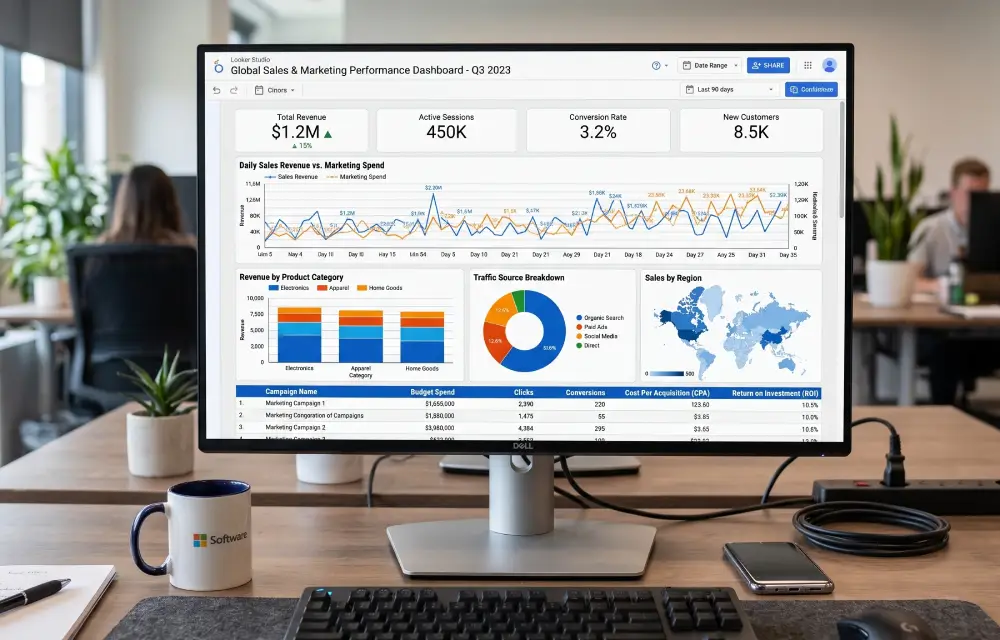
Google Ads search term data reveals customer language and intent that should inform decisions well beyond the paid search account itself.
Search Term Language
Specifically, the exact phrases customers type before converting reveal how they think about the problem your client solves. Furthermore, this language often differs from how the business describes itself internally.
Apply to: website copy, ad headlines, content titles, email subject linesAudience Segment Performance
Furthermore, which demographic, interest, or remarketing segments convert best reveals who the actual buyer is — sometimes different from who the client assumed. Consequently, this reshapes targeting across every channel.
Apply to: buyer personas, social media targeting, content audience strategyWinning Ad Copy Themes
Specifically, ad copy that consistently outperforms reveals which value propositions, objections, or benefits resonate most. Moreover, this is direct evidence of messaging that works — not a guess.
Apply to: homepage messaging, sales scripts, case study framingSeasonal and Timing Patterns
Consequently, Google Ads reveals exactly when demand rises and falls throughout the year — data that’s usually more granular and reliable than general market assumptions.
Apply to: budget planning, campaign launch timing, content calendar scheduling“Google Ads isn’t just a channel you manage. It’s a live focus group running every day, telling you exactly what your customers want to hear — if anyone’s actually listening.”
Why This Disconnect Matters More at Scale
Specifically, the gap between Google Ads data and marketing strategy widens as agencies grow, not narrows. Furthermore, at three or four clients, the same person often manages both the campaigns and the strategic relationship — so insight naturally flows because it lives in one head. However, at fifteen or twenty clients, PPC specialists and account strategists are often different people, sometimes on different teams entirely.
Consequently, the structural distance between the person who sees the search term data daily and the person making strategic recommendations to the client grows with every additional client the agency signs. Therefore, without a deliberate process to bridge that gap, larger agencies actually extract less strategic value from their Google Ads data than smaller ones — despite having significantly more of it.
How to Build the Bridge Between Google Ads and Marketing Strategy
Specifically, closing this gap doesn’t require restructuring your team or hiring a dedicated insights analyst. Furthermore, it requires a consistent process that surfaces the right Google Ads data to the right people at the right cadence. Therefore, here’s a practical five-step approach that works regardless of agency size.
Review search terms monthly, not just for negative keywords
Specifically, most PPC specialists review search terms to find wasted spend and add negative keywords. Furthermore, add a second lens: which converting search terms reveal language or intent worth sharing with the wider team? Consequently, this single habit change surfaces most of the valuable insight without any additional tooling.
Include a strategic insight section in every client report
Furthermore, most Google Ads sections in client reports focus entirely on performance metrics — spend, conversions, ROAS. Specifically, add a short section explicitly asking: what did we learn this month that applies beyond the ads account? Consequently, this forces the insight to get written down and shared, rather than staying in the PPC specialist’s head.
Bring Google Ads data into quarterly strategy reviews directly
Specifically, don’t let quarterly strategy conversations rely purely on summary reports. Furthermore, pull in actual search term examples, winning ad copy, and audience performance data as source material for the discussion. Therefore, the strategy conversation grounds itself in real customer language rather than abstracted metrics.
Connect PPC and content or SEO planning explicitly
Furthermore, Google Ads search term data often reveals commercial keyword intent that organic content strategy should target. Specifically, schedule a recurring conversation — even quarterly — between whoever manages paid search and whoever manages content or SEO. Consequently, both channels reinforce each other instead of operating independently.
Centralise all channel data in one regular report
Specifically, when Google Ads data appears in the same report as GA4, Meta, and Search Console data — reviewed together, on the same cadence — patterns become visible that stay hidden when each platform gets reviewed in isolation. Furthermore, this structural change does more to surface cross-channel insight than any individual analytical effort.
Specifically, most of this bridge-building work fails not from lack of insight but from lack of a consistent forum where that insight gets shared. Furthermore, a monthly report that combines Google Ads with the rest of the marketing picture — rather than isolating it in its own document — creates that forum automatically. Consequently, insights that would otherwise stay trapped in a PPC specialist’s head get surfaced simply because the reporting structure requires it.
How Automated Reporting Naturally Closes the Gap
Specifically, one of the underappreciated benefits of automated, consolidated reporting is that it structurally forces cross-channel visibility. Furthermore, when Google Ads, GA4, Meta, and Search Console data all appear in the same document — reviewed by the same person, at the same time, every month — patterns connecting the channels become far easier to spot.
Consequently, an account manager reviewing a single automated report that shows Google Ads search term trends alongside GA4 landing page performance and organic search rankings will notice a converging theme far more readily than someone checking four separate platform dashboards on four separate occasions. Therefore, consolidated automated reporting doesn’t just save time — it actively improves the quality of strategic thinking by presenting the full picture in one place.
What this looks like in practice: Specifically, an agency using consolidated automated reporting notices that a particular messaging theme performs well in Google Ads. Furthermore, because that data sits in the same report as organic search performance, the account manager notices the same theme has weak organic visibility — a content gap. Consequently, that observation, which might never have surfaced from isolated platform checks, becomes a specific, actionable recommendation in the next strategy conversation.
See your Google Ads data alongside your entire marketing picture
RaiseReturn connects to Google Ads, GA4, Meta Ads, Search Console, and PageSpeed — pulling every channel into one branded, AI-written report. Stop losing strategic insight in isolated platform dashboards. First 30 days free, no card required.
Start Your Free Trial →Common Questions About Google Ads and Marketing Strategy
Specifically, Google Ads generates some of the most valuable customer insight any marketing channel produces — and most of it never leaves the platform. Furthermore, fixing that isn’t about running better campaigns. It’s about building the structural bridge that lets existing insight travel to where strategic decisions actually get made.
Stop optimising in isolation. Start listening to what the data’s already telling you.